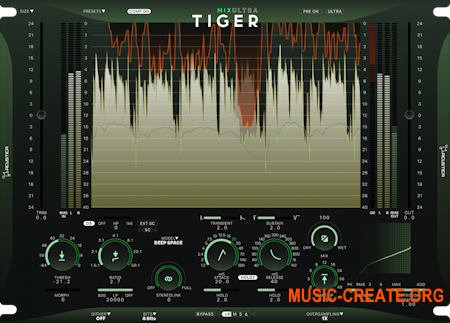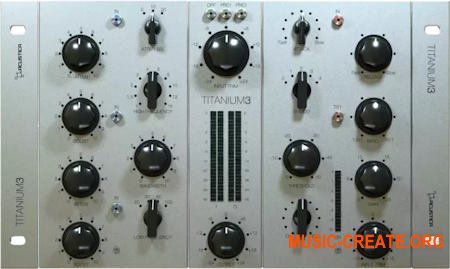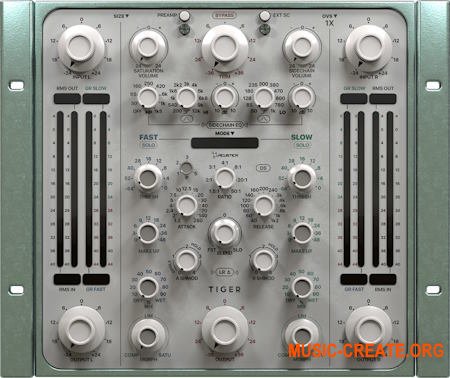
Acustica Audio Tiger - это первый набор плагинов Acqua (VST/VST3/AAX/AU) в Core 19, основанный на нашей технологии Hyper второго поколения, охватывающей превосходную коллекцию самых известных компрессоров Acustica.
В последнее время мы стали свидетелями распространения программного обеспечения, посвященного динамике: тенденция последних выпусков часто фокусируется на преодолении ограничений аналогового сжатия при сохранении музыкальности, которая всегда отличала его.
В последних продуктах управление сайдчейн улучшено за счет более полных цепей эквалайзера или расширено за счет одновременного управления на основе независимых детекторов для обработки переходных процессов и устойчивой части сигнала. Мы объединили наш опыт, чтобы попытаться решить эту проблему в соответствии с нашим видением: идея Acustica Audio Tiger заключается в объединении наших моделей и некоторых самых последних концепций для создания наилучшего возможного опыта для "наших" пользователей.
Чем не Tiger?
Acustica Audio Tiger - это не компрессор, который пытается имитировать определенный винтажный предмет. Идея в том, чтобы создать похожий на хамелеона предмет, который пытается имитировать их все, преодолевая ограничения каждого из них. Если вам нужна точная копия определенного изделия, у нас наверняка найдется более актуальная вещь в нашем каталоге. Мы не включили в сигнальный тракт конечные фиксаторы и ограничители "кирпичная стена", чтобы не дублировать функциональность других продуктов: в результате это привело бы к ненужному усложнению и дублированию функциональности, уже имеющейся в других продуктах.
Что вы получаете
Tiger includes two different GUIs to choose from:
TIGER, TIGER MIX, TIGER MAST: plugins based on a 3D ‘Acustica’s classic-style’ GUI.
TIGER ‘Flat’, TIGER MIX 'Flat', TIGER MAST 'Flat' & FIRE THE TIGER: plugin versions based on a 2D ‘modern-style’ GUI.
If you are an 'analogue-lover', you can work with Acustica's classic style interface; if you want to experience something never seen before here, choose the 2D modern interface(Tiger flat, Tiger Mix flat & Tiger Mast flat).
Key Features
Here is a summary of Tiger's main features:
Tiger includes four different plugins to choose from (‘Tiger flat’ and Tiger; 'Tiger Mix flat' and Tiger Mix).
Tiger implements a long list of compression curves accurately sampled from the best analog compressors and software. We have found that this is a relatively rare added value in software implementations (often, these curves are clean, synthesized, modified, and are not the actual result of a sampling operation). In this respect, Tiger copies Ash's strategy for clippers, but in the realm of compression.
Tiger implements the shapes of attack and release curves (ATTACK and RELEASE) in the detectors from the best HARDWARE we have measured over the years. The multi-segment shapes endow the product with program-dependent characteristics (auto-attack and auto-release on steroids).
Tiger implements in its detectors modulators of the shape for attack and release times (ASHMOD, RSHMOD) coming from the best SOFTWARE (yes, this time software as well) and hardware attack and release curves we have analyzed. It's the first time we have introduced release modulation in one of our products.
Tiger implements a HOLD functionality for both the attack and the release (this combined presence is also quite rare in software compressors).
Tiger implements multiple variable-weighted detectors for handling transients simultaneously concerning the rest of the signal (this is also a program-dependent feature).
Tiger implements a concept of a managed fast compressor and slow compressor to balance aggressive and soft compressions within the same pattern precisely.
Tiger implements an integrator (POWER) in the detectors to parametrically manage transient response speed. In contrast to a purely PEAK or RMS compressor, Tiger can represent compressors that implement detectors based on variable-pitch RMS power measurements.
Tiger implements a circuit in the sidechain path (DEEP SPACE) dedicated to optimizing distortion in the presence of fast time constants.
Tiger implements a true look-ahead on the attack (thus independent of the release) that can optimize distortion in the presence of fast time constants.
Tiger implements a relatively comprehensive sidechain equalizer based on a high-pass filter and a dual semi-parametric peak or shelf-type equalizer and accepts external sidechains.
Tiger implements sophisticated oversampling (which has become a distinctive feature in the latest products we have released), characterized by a particularly transient-friendly impulse response and zero phase alteration.
In each signal path, each dynamic element is independent of the input channels (in fact, Tiger consists of 6 separate compressors).
Tiger implements an intuitive morphing control (MORPH) that allows each of Tiger's dynamic elements to be seamlessly transformed from a compressor to a limiter to a saturator while simultaneously handling the stereo-link intuitively.
Tiger implements skins with 3D graphics and flat 2D graphics for lovers of fast and intuitive interfaces. The interface is highly responsive, with a sidechain path, signal delta, and bypass listening.
Tiger also implements low-latency versions (especially without oversampling, as the latency is relatively low), especially for the TIGER MIX version, designed for tracking.
Tiger includes Resizable and responsive GUI.
Tiger has a great and distinctive sound.
TIGER, TIGER MIX, TIGER MAST: plugins based on a 3D ‘Acustica’s classic-style’ GUI.
TIGER ‘Flat’, TIGER MIX 'Flat', TIGER MAST 'Flat' & FIRE THE TIGER: plugin versions based on a 2D ‘modern-style’ GUI.
If you are an 'analogue-lover', you can work with Acustica's classic style interface; if you want to experience something never seen before here, choose the 2D modern interface(Tiger flat, Tiger Mix flat & Tiger Mast flat).
Key Features
Here is a summary of Tiger's main features:
Tiger includes four different plugins to choose from (‘Tiger flat’ and Tiger; 'Tiger Mix flat' and Tiger Mix).
Tiger implements a long list of compression curves accurately sampled from the best analog compressors and software. We have found that this is a relatively rare added value in software implementations (often, these curves are clean, synthesized, modified, and are not the actual result of a sampling operation). In this respect, Tiger copies Ash's strategy for clippers, but in the realm of compression.
Tiger implements the shapes of attack and release curves (ATTACK and RELEASE) in the detectors from the best HARDWARE we have measured over the years. The multi-segment shapes endow the product with program-dependent characteristics (auto-attack and auto-release on steroids).
Tiger implements in its detectors modulators of the shape for attack and release times (ASHMOD, RSHMOD) coming from the best SOFTWARE (yes, this time software as well) and hardware attack and release curves we have analyzed. It's the first time we have introduced release modulation in one of our products.
Tiger implements a HOLD functionality for both the attack and the release (this combined presence is also quite rare in software compressors).
Tiger implements multiple variable-weighted detectors for handling transients simultaneously concerning the rest of the signal (this is also a program-dependent feature).
Tiger implements a concept of a managed fast compressor and slow compressor to balance aggressive and soft compressions within the same pattern precisely.
Tiger implements an integrator (POWER) in the detectors to parametrically manage transient response speed. In contrast to a purely PEAK or RMS compressor, Tiger can represent compressors that implement detectors based on variable-pitch RMS power measurements.
Tiger implements a circuit in the sidechain path (DEEP SPACE) dedicated to optimizing distortion in the presence of fast time constants.
Tiger implements a true look-ahead on the attack (thus independent of the release) that can optimize distortion in the presence of fast time constants.
Tiger implements a relatively comprehensive sidechain equalizer based on a high-pass filter and a dual semi-parametric peak or shelf-type equalizer and accepts external sidechains.
Tiger implements sophisticated oversampling (which has become a distinctive feature in the latest products we have released), characterized by a particularly transient-friendly impulse response and zero phase alteration.
In each signal path, each dynamic element is independent of the input channels (in fact, Tiger consists of 6 separate compressors).
Tiger implements an intuitive morphing control (MORPH) that allows each of Tiger's dynamic elements to be seamlessly transformed from a compressor to a limiter to a saturator while simultaneously handling the stereo-link intuitively.
Tiger implements skins with 3D graphics and flat 2D graphics for lovers of fast and intuitive interfaces. The interface is highly responsive, with a sidechain path, signal delta, and bypass listening.
Tiger also implements low-latency versions (especially without oversampling, as the latency is relatively low), especially for the TIGER MIX version, designed for tracking.
Tiger includes Resizable and responsive GUI.
Tiger has a great and distinctive sound.
Сайт разработчика: https://www.acustica-audio.com/shop/products/TIGER
Внимание! У Вас нет прав для просмотра скрытого текста. Для получения доступа жми на кнопку ниже